
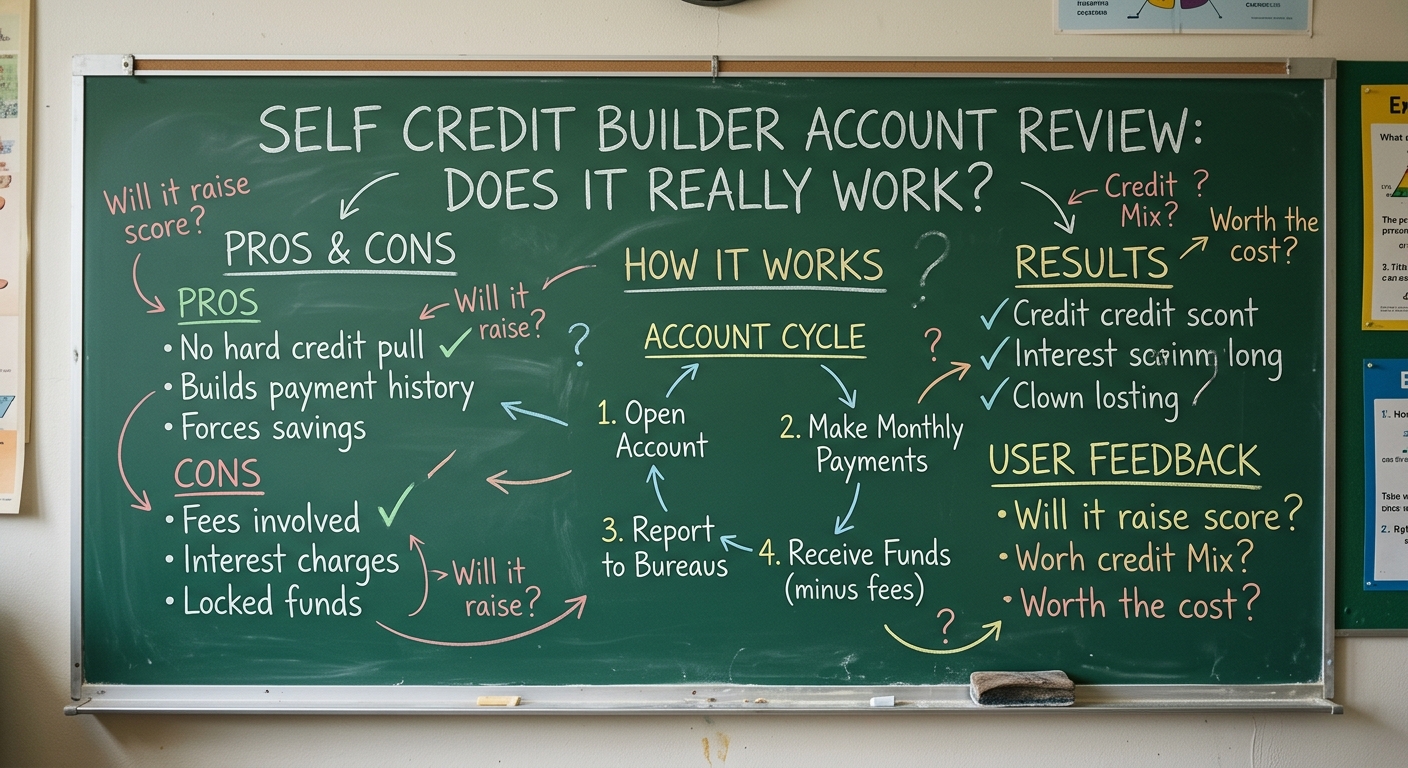
Self Credit Builder Account Review: Does It Really Work?
Yes, mechanically. Self reports your payments to all three credit bureaus, the same way any legitimate installment account does. So on-time payments genuinely build payment history and account age. Whether it’s the right choice for you depends on details that don’t always make it into shorter reviews. However, that includes the exact payment tiers, a real answer on whether it accepts an ITIN, and what happens if you need to cancel early. It also means an honest look at the company’s reputation — including a discrepancy in review scores worth knowing about upfront.
Self Credit Builder Account Review: How It Actually Works
Self offers four payment tiers over a fixed 24-month term:
| Monthly Payment | Term | Approximate APR |
|---|---|---|
| $25/month | 24 months | ~15.51%–15.92% |
| $35/month | 24 months | ~15.51%–15.92% |
| $48/month | 24 months | ~15.51%–15.92% |
| $150/month | 24 months | ~15.51%–15.92% |
(APR is reported as a fairly narrow range across tiers, rather than varying dramatically by payment amount. So confirm the exact current APR for your chosen tier directly with Self before enrolling.)
Your payments are held in an FDIC-insured certificate of deposit with one of Self’s partner banks. So your money is protected the same way a bank deposit is, regardless of Self’s own financial standing. At the end of the 24-month term, you receive the funds back, minus fees and interest paid. There’s no hard credit check to open an account, consistent with how credit builder loans are structured generally. See our full comparison of credit builder loan providers for how Self stacks up against alternatives like Credit Strong, MoneyLion, and credit-union options.
Late payments matter here just like anywhere else: a payment 15 or more days late triggers a fee of up to 5% of that month’s scheduled payment. That’s on top of the credit-reporting impact of a late payment itself.
Eligibility Requirements
To open a Self Credit Builder Account, you generally need:
- To be at least 18 years old
- A valid bank account, debit card, or prepaid card to make payments
- An email address and phone number
- A Social Security number
- Permanent U.S. residency with a physical U.S. address
- No recent disqualifying items on ChexSystems (the specialty reporting agency that tracks banking behavior, separate from your credit history)
A note on ITIN eligibility, worth being direct about: it isn’t clearly confirmed whether Self’s Credit Builder Account accepts an ITIN in place of a Social Security Number. Self publishes general educational content about ITIN-based credit building for immigrants. But that content addresses other issuers’ policies, rather than confirming its own product’s requirements. And third-party eligibility summaries list only an SSN as a requirement. If you’re applying with an ITIN specifically, confirm directly with Self before assuming this account is available to you. Don’t rely on either their general blog content or this review as confirmation either way.
The Self Visa Secured Credit Card Add-On
Once you’ve made at least three on-time Credit Builder Account payments and built up at least $100 in savings progress, you may become eligible. That’s for Self’s secured Visa card. What makes this different from opening a separate secured card elsewhere is simple. Instead of requiring a new, separate deposit, it draws on the funds already accumulating in your Credit Builder Account. That fund serves as its collateral. So you’re not tying up additional money beyond what you’re already committing to the loan. The card carries no annual fee in year one, then $25/year afterward.
This effectively lets you add a revolving account (which affects utilization) alongside your installment loan (which doesn’t) — without a second deposit. That’s a genuinely useful structural feature if your goal includes building both account types. See our secured card vs. credit builder loan guide for more on that combination.
Does It Actually Raise Your Score? What the Data Actually Shows
Self reports that its customers see an average 32-point credit score increase. It’s worth being clear about what this figure is and isn’t: it’s a company-reported statistic, not an independent, third-party study with a published methodology. So treat it as a general directional signal from the company itself, rather than a guaranteed or externally verified outcome for any individual account.
What’s more reliably true is grounded in how credit scoring actually works, rather than a marketing figure. On-time payments over time genuinely build payment history (the single heaviest-weighted scoring factor) and account age. Also, an installment account can meaningfully help your credit mix, if it’s your first or only account type. The mechanism is real. Still, the exact number of points any individual sees will vary significantly. That depends on their starting point, what else is on their credit file, and how consistently they pay on time.
Does Self Credit Builder Work? The Real Risk of Cancelling Early
This is worth flagging clearly, since it’s a common point of regret reported by users. If you need your money back before the 24-month term completes, you can cancel. But doing so can hurt the credit benefit you were building toward. And you may not get back everything you’ve paid in — fees and accrued costs are typically deducted from your balance, before what remains is returned. A Credit Builder Account is a genuine two-year commitment, not a flexible savings account you can freely dip into. So choose a payment tier you’re confident you can sustain for the full term, rather than the highest one you can technically afford today.
Reputation Check: What Reviews Actually Say
Self’s Trustpilot rating sits at 4.1 out of 5 («Great»), reflecting a substantial volume of customer reviews. It’s worth noting, in the interest of a balanced picture: at least one other review aggregator showed a notably lower score around the same period. That score was 1.7 out of 5. It’s a real discrepancy between platforms, rather than universal consensus. So it’s worth being aware of, if you’re relying heavily on star ratings to decide.
On the regulatory side, Self is not a BBB-accredited business. At the time of this review, it also held a «Not Rated» status. Because the company was in the process of responding to previously closed complaints, that status applied specifically then. Neither of these facts alone signals fraud or serious wrongdoing. BBB accreditation is optional and tied to a fee, and «Not Rated» is a distinct status from a poor letter grade. But it’s reasonable due diligence to check Self’s current BBB profile directly before enrolling, since these statuses can change.
Who Self Is a Good Fit For — and Who Should Look Elsewhere
Self is a reasonable fit if: you don’t have access to a credit union that offers a cheaper credit builder loan, and you want a low starting payment tier ($25/month). It’s also a fit if you’re confident you can commit to the full 24-month term without needing early access to the funds.
Consider an alternative if: you qualify for a credit union membership. DCU’s 5.00% APR with no listed fees is meaningfully cheaper over a comparable term (see our full provider comparison). Or, you need to apply with an ITIN and can’t get direct confirmation from Self that it’s accepted. Or, you think there’s a real chance you’ll need the funds back before two years is up. In that case, a shorter-term product elsewhere may fit better.
Frequently Asked Questions
Is Self a legitimate company, or is this a scam?
Self is a legitimate, operating financial technology company. Its accounts are held at FDIC-insured partner banks, which protects your funds regardless of Self’s own business standing. Legitimate and «the right fit for your specific situation» are different questions. The concerns worth weighing here — fees relative to cheaper alternatives, the early-cancellation risk, unconfirmed ITIN eligibility — are about fit and cost, not fraud.
Can I change my payment tier after opening an account?
This varies — check current account management options directly with Self, since payment flexibility after enrollment isn’t something to assume without confirming.
Does opening a Self account involve a hard credit inquiry?
No. Self states no hard credit check is required to open a Credit Builder Account. That’s consistent with how credit builder loans work as a category generally.
How is Self different from a secured credit card?
A Credit Builder Account reports as an installment loan and doesn’t affect your utilization. However, its optional secured card add-on does report as revolving credit, and does affect utilization. See our secured card vs. credit builder loan comparison for the full mechanical breakdown.
This article is for informational purposes only and is not financial advice. Terms, fees, eligibility requirements, and company ratings change over time and can vary from what’s reflected here — confirm current details directly with Self before enrolling, and check the BBB and review platforms for the most current standing before making a decision.