
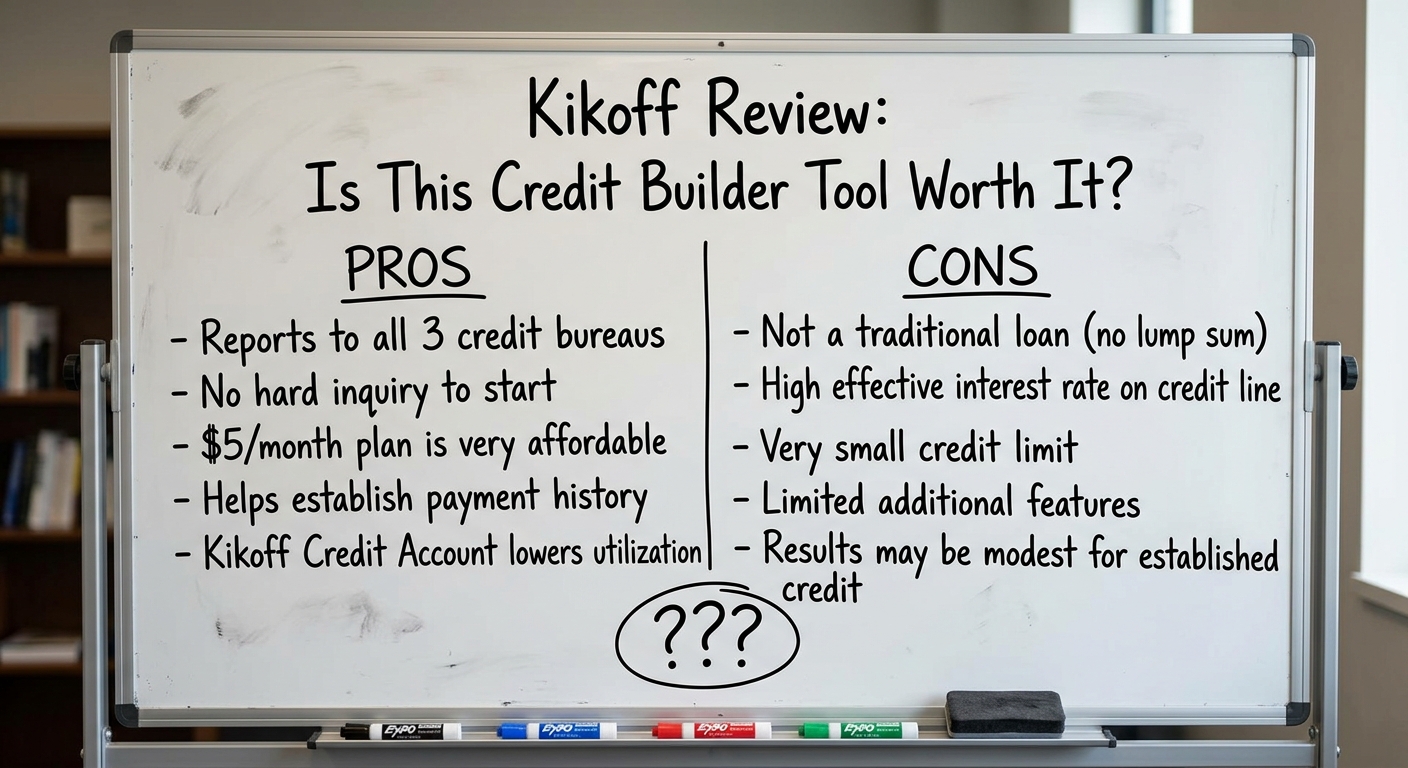
Kikoff Review: Is This Credit Builder Tool Worth It?
Kikoff is genuinely different from the credit builder loans covered elsewhere on this site. Understanding that difference is the key to deciding if it’s worth it. Instead of an installment loan you pay down over a fixed term, Kikoff sells you a small, non-spendable «credit line.» That line exists mainly to be reported to the bureaus. Its real value proposition is about utilization, not payment history diversity.
How Kikoff Actually Works — and the Part Most People Misunderstand
Kikoff offers three subscription tiers:
| Plan | Monthly Cost | Reported Credit Line |
|---|---|---|
| Basic | $5/month | $750 |
| Premium | $20/month | $2,500 |
| Ultimate | $35/month | $3,500 |
Here’s the part that trips people up: the credit line isn’t something you spend on anything you want. According to Kikoff’s own explanation, the tradeline exists specifically «to finance the purchase of your monthly plan.» In other words, the only thing it’s ever used for is covering your own subscription fee, paid back monthly via debit card. You can’t use it for groceries, gas, or anything else the way a secured card’s credit line works. There’s no disclosed APR or interest on top of the flat monthly fee.
There’s no hard credit check to open an account. Your account — the reported balance and the low monthly repayment — is reported to Equifax, Experian, and TransUnion each month.
Why This Reports as Revolving, Not Installment — and Why That Matters
This is the single most important structural fact about Kikoff. It’s what actually differentiates it from Self or Credit Strong, covered in our full credit builder loan comparison. Kikoff’s account reports as a revolving tradeline — the same category as a credit card — rather than an installment loan.
That matters because revolving accounts are the ones that directly affect your credit utilization — the second-heaviest scoring factor, at roughly 30% of your score. Here’s the idea behind Kikoff’s plans. A reported credit line of $750, $2,500, or $3,500 sits against a balance of only $5–$35 owed per month. That gap can produce a very low utilization ratio on that specific tradeline. An installment credit builder loan structurally can’t do this, since installment loans aren’t factored into utilization at all. (See our full explainer on how each account type affects your score for the underlying mechanics.) This is presented as the intended mechanic, based on how the product is described. However, treat the exact scoring-model treatment as the general expected effect, not a guaranteed, independently audited outcome for every credit file. Multiple sources describe Kikoff as helping maintain low utilization, but none confirmed this with full certainty.
What Else Kikoff Sells You
Beyond the core credit-line product, Kikoff offers several add-ons, some free and some separately priced:
- Rent reporting — reports past and future rent payments to Equifax and TransUnion
- Bill/utility reporting — reports to TransUnion specifically (notably, only one bureau for this feature, per Kikoff’s own site — a narrower benefit than the three-bureau reporting on the core credit line)
- Credit monitoring — monthly reports across all three bureaus
- «Fynn» — an AI-based financial coaching feature
- Privacy protection — a data-broker removal service
A practical caution worth flagging clearly: several of Kikoff’s real-world complaints, detailed below, center on unexpected charges beyond the advertised $5/month. It’s worth reviewing exactly what you’re being billed for, and confirming which add-ons are included versus separately charged. Don’t assume your monthly cost will stay at the base tier price.
Does It Actually Improve Your Score? What the Data Shows
One figure commonly cited is sourced to Kikoff’s own reporting. It claims users starting with scores below 600 see an average 58-point improvement «during the lifetime of the account.» As with the similar figure we flagged in our Self Credit Builder review, it’s worth being clear about what this is. It’s a company-reported statistic, without a published independent methodology or a clearly defined timeframe for «lifetime of the account.» That makes it a useful directional signal, not a guarantee, and not equivalent to an independently conducted study.
What’s mechanically true, regardless of that specific figure, is this: consistent on-time payments and a low reported utilization ratio are both real, established scoring factors. The mechanism behind Kikoff’s value proposition is grounded in real scoring mechanics. Still, the exact number of points any individual will see varies by their starting credit profile.
Reputation Check: A Genuinely Mixed Picture
The positive side: Kikoff Lending, LLC holds an A+ rating and BBB accreditation — a notably stronger regulatory standing than some other credit-building products reviewed on this site. Its Trustpilot rating sits at 4.0 out of 5 across roughly 2,300 reviews, a solid score reflecting broadly positive customer sentiment.
The recurring complaint pattern worth knowing about: both the BBB profile and Trustpilot reviews surface a consistent theme around billing and cancellation. Customers report charges beyond the advertised $5 — one specific complaint cited being billed $80. Others describe difficulty getting a full refund, and friction when trying to cancel or close an account. A smaller number of reviewers also reported credit score drops tied to missed payments or account closures.
None of this is unique to Kikoff among subscription-based financial products. But it’s a real enough pattern across two independent review sources to take seriously. Read your specific plan’s terms carefully before enrolling, and keep records of any cancellation request you submit.
How to Cancel Properly (Given the Complaint Pattern Above)
Given how often cancellation friction shows up in Kikoff’s reviews, a few precautions are worth taking if you decide to close your account:
- Cancel through the account’s official cancellation flow, not just by removing a payment method. A failed payment can itself trigger negative reporting, rather than a clean account closure.
- Get written confirmation of the cancellation (an email or in-app confirmation), and keep it.
- Monitor your statement for at least one billing cycle afterward to confirm charges have actually stopped.
- Check your credit report afterward to confirm the account is reported as closed rather than left open or reported inaccurately.
Who Kikoff Is a Good Fit For — and Who Should Look Elsewhere
A reasonable fit if: you specifically want the utilization benefit of a reported revolving tradeline at a low monthly cost. You should also be comfortable with a subscription-style ongoing fee, rather than a fixed-term loan, and diligent about monitoring your billing.
Consider an alternative if: you’d rather build installment history and credit mix. A credit builder loan is a better structural fit for that specific goal. Also consider an alternative if you want your funds back at the end of a term. Self’s or Credit Strong’s products work that way, returning your payments. Kikoff’s fee is a pure ongoing cost, not a forced-savings structure, so you don’t get anything back. Or, if you’re simply wary of subscription-style billing given the complaint pattern above, that’s reason enough on its own.
Frequently Asked Questions
Do I ever actually receive any money from Kikoff’s credit line? No — this is the most commonly misunderstood part of the product. The «credit line» exists solely to cover your own monthly subscription cost. It isn’t spendable cash, or purchasing power, the way a credit card’s limit is.
Is Kikoff cheaper than a credit builder loan like Self? It depends on what you’re optimizing for. Kikoff’s Basic plan at $5/month is one of the lowest entry costs in this category. But unlike a credit builder loan, you don’t get any money back at the end — it’s a pure ongoing fee, rather than forced savings. Compare total cost against your actual goal (utilization benefit vs. installment history plus a lump sum back) rather than monthly price alone.
Does Kikoff report to all three credit bureaus? The core credit-line product does. Its bill-reporting add-on, notably, reports to TransUnion only — worth knowing if your goal is influencing all three of your reports specifically.
Can closing my Kikoff account hurt my credit score? Based on complaint patterns reviewed, some users have reported this happening, particularly in connection with missed payments or account closures. Following the cancellation precautions above reduces this risk, but it’s a real enough pattern to take seriously rather than dismiss.
This article is for informational purposes only and is not financial advice. Kikoff’s plans, fees, and terms are set by the company and can change — confirm current pricing and terms directly on Kikoff’s site before enrolling, and review your specific billing statement carefully after signing up.