
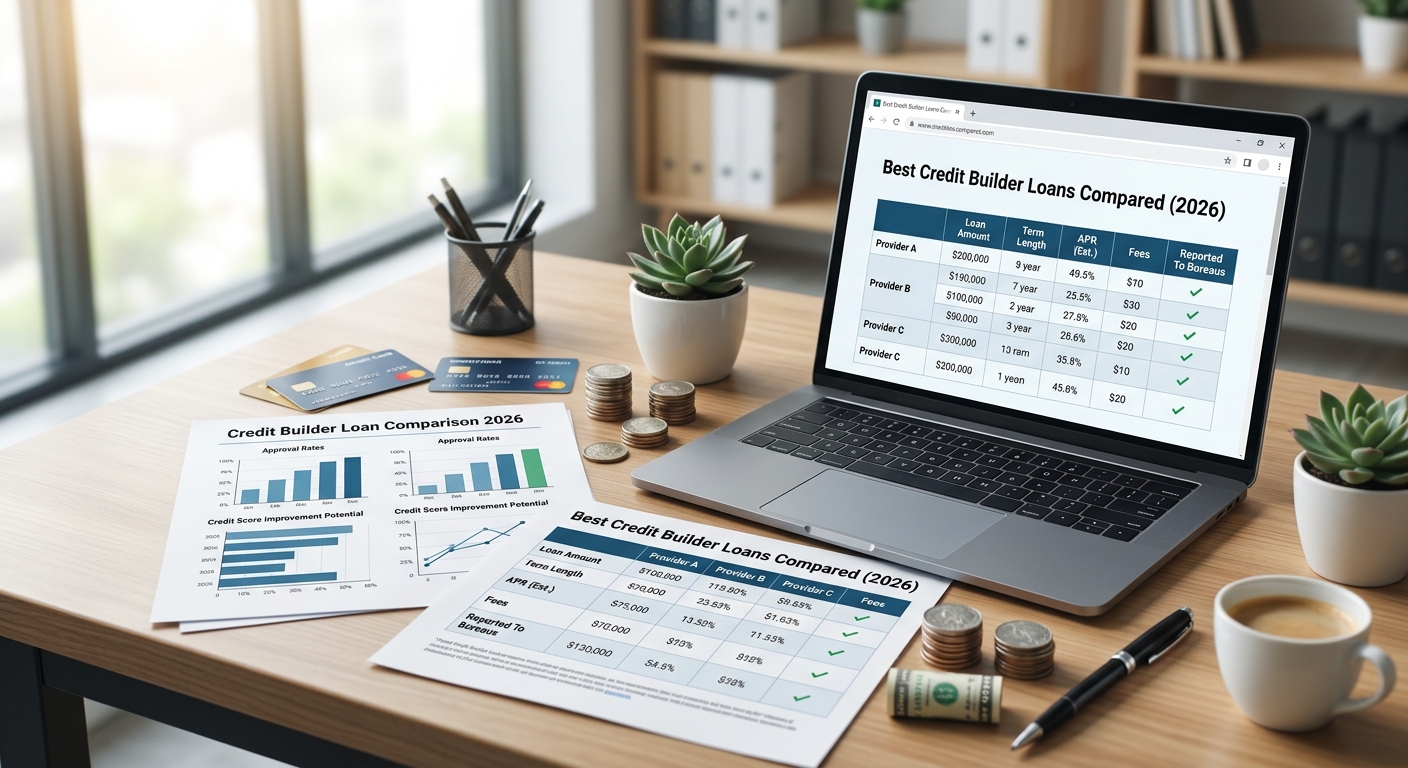
Best Credit Builder Loans Compared (2026)
Unlike secured cards — where the underlying mechanics are fairly similar across issuers and the deposit is refundable either way — credit builder loans vary a lot more in what they actually cost you by the time the term ends. For example, the cheapest option below charges 5% APR with no fees at all. But the most expensive charges a $19.99-a-month membership fee for access to a loan as small as $1,000. So here’s how to tell the difference before you commit to a term that typically runs a year or two.
How a Credit Builder Loan Actually Works
Before comparing providers, it’s worth being clear on the mechanics, since they’re genuinely different from a typical loan.
You don’t receive the loan amount upfront to spend. Instead, the lender sets that amount aside — usually in an FDIC-insured savings account or certificate of deposit (CD) — that you can’t access yet. You then make fixed monthly payments over a set term, commonly 12 to 24 months. So each payment is reported to all three major credit bureaus as an installment account — the same category as a car loan or student loan. Once the term is complete, the funds are released to you — sometimes with a small amount of interest earned along the way, minus whatever fees applied.
So, in effect, you’re paying yourself back over time. The credit-reporting benefit happens as a byproduct of that structured saving. This is different from a secured credit card, which reports as a revolving account and directly affects your credit utilization. However, a credit builder loan doesn’t touch utilization at all, since installment loans aren’t measured that way. See our secured card vs. credit builder loan comparison if you’re deciding between the two rather than which specific loan to choose.
What Actually Makes One Credit Builder Loan Cost More Than Another
Three variables drive the real cost difference between providers, and it’s worth understanding each before looking at the comparison table:
- APR — the interest charged on the loan amount, same concept as any other loan.
- Fees — a one-time administrative fee, a recurring monthly account or membership fee, or both. So this is where the biggest cost differences actually show up, more than APR alone.
- Whether you earn any interest back on the funds held in your account while you’re paying it down. However, some providers hold your funds in an interest-bearing CD or savings account, which offsets some of what you’re paying in APR and fees. Others don’t.
A loan with a lower APR but a high monthly account fee can easily cost more in total than one with a higher APR and no fees at all. So always calculate total cost — monthly payment × number of months, plus any one-time fees, minus any interest earned — rather than comparing APR figures alone.
Best Credit Builder Loans: Comparison Table
| Provider | Loan Amount | Term | APR | Fees | Credit Check | Funds Held In |
|---|---|---|---|---|---|---|
| Self | $500–$1,700 (via 4 payment tiers: $25/$35/$48/$150 per month) | 24 months | ~15.51%–15.92% | Late fee only (up to 5% if 15+ days late) | No hard check | FDIC-insured CD |
| Credit Strong (Instal) | $1,010 | Not specified beyond monthly structure | 15.61% | $28/month (all-inclusive) | No hard check | Savings/CD-style account |
| Credit Strong (Magnum 4000) | $4,000 | Multi-year | 11.11% | $55/month + $25 one-time admin fee | No hard check | Savings/CD-style account |
| MoneyLion Credit Builder Plus | Up to $1,000 | Not specified | 5.99%–29.99% | $19.99/month membership | Soft inquiry only | Varies; partial access possible before full repayment |
| DCU (credit union) | $500–$3,000 | 12–24 months | 5.00% | None listed | Not specified | Interest-earning savings account |
| BMO | $1,000+ | 24–60 months | 10.80%–19.12% | $75 one-time processing fee | No minimum score required | Interest-earning CD |
(Terms and availability change — confirm current figures directly with each provider before applying; this table reflects research at the time of writing.)
The Honest Read on the Best Credit Builder Loans
There isn’t a single winner. Instead, it depends on what you’re optimizing for.
Cheapest Overall, If You Qualify
DCU’s 5.00% APR with no listed fees is meaningfully cheaper than every other option here. However, the catch is credit union membership eligibility — DCU and most credit unions require some qualifying connection (employer, location, family relationship to an existing member, or sometimes a small one-time donation to a partner organization) to join. So if you already qualify for a credit union membership somewhere, checking whether they offer a credit builder loan is worth doing before looking at fee-charging alternatives.
Most Broadly Accessible Without a Membership Requirement
Self doesn’t require credit union eligibility or an existing banking relationship, and its four payment tiers (starting at $25/month) make it approachable across a wide range of budgets. Its APR is on the higher end of this list. Still, there’s no recurring account fee stacked on top.
Best for a Larger Loan Amount, for Credit-Mix Purposes
Credit Strong’s larger products (Magnum 4000, Magnum XL 10K) offer meaningfully bigger loan amounts than Self or MoneyLion. That can matter if your goal includes diversifying your credit mix with a more substantial installment account. However, the monthly account fees add up faster on these larger products. So run the full-term math before committing.
Worth Extra Scrutiny Before Choosing
MoneyLion’s $19.99/month fee, applied to a loan as small as $1,000 over a term of a year or more, can end up being one of the more expensive ways to build the same amount of installment history compared to Self or DCU. Still, the membership includes other app features beyond the credit builder loan itself. So it may be worth it if you’ll use those — but it isn’t the cheapest way to accomplish credit building alone.
How to Calculate the Real Cost Before You Commit
- Multiply the monthly payment by the number of months in the term.
- Add any one-time fees (administrative or processing fees).
- Subtract any interest you’re told you’ll earn on the held funds, if the provider pays any.
- Compare that total net cost against the loan amount — the difference is what you’re actually paying for the credit-building benefit, separate from the amount you get back.
Providers don’t always present this calculation clearly upfront. So doing it yourself, before applying, is the only reliable way to compare across providers with genuinely different fee structures.
What All Reputable Credit Builder Loans Should Have in Common
Regardless of which provider you choose, a few things should hold true — treat their absence as a red flag:
- Reporting to all three major credit bureaus (Experian, Equifax, TransUnion) — a product that only reports to one or two bureaus provides a meaningfully weaker benefit, since not every lender you apply to later will pull from the same bureau it reported to.
- FDIC insurance on the account holding your funds — this protects your money the same way a bank deposit is protected, regardless of the lender’s own financial stability.
- No hard credit check for approval — this is close to universal across genuine credit builder loan products, since the entire structure is designed around not needing an existing credit file to qualify. However, if a «credit builder loan» you’re considering does require a hard credit check, that’s a sign it may not function the way this category typically works.
- Clear, published fee and APR terms before you apply — if a provider’s cost structure isn’t easy to find or calculate in advance, that’s worth treating with some caution.
Frequently Asked Questions
Can I have more than one credit builder loan at the same time?
Yes, though as with opening multiple new accounts of any kind, doing so all at once can temporarily affect your average account age more than staggering them. So there’s no rule against holding more than one. But there’s also little added benefit to duplicating essentially the same account type across providers, instead of choosing one and, if useful, later adding a different account type (like a secured card).
Do credit builder loan payments show up as «on time» the same way a credit card payment does?
Yes. In other words, payment history is reported based on whether your payment was made on time relative to its due date — the same underlying mechanic as any other credit account, regardless of whether it’s a credit card or an installment loan.
What happens if I miss a payment?
Beyond any late fee the provider charges, a missed payment is reported to the credit bureaus as such. That can meaningfully hurt your payment history — the single heaviest-weighted scoring factor. So this is true across every provider on this list: a credit builder loan doesn’t come with more forgiving reporting standards than any other account.
Is a credit builder loan a good idea if I can already qualify for a secured card?
It can still be worth it, mainly for the credit-mix benefit of holding an installment account alongside a revolving one — see our full secured card vs. credit builder loan breakdown for how the two compare directly.
This article is for informational purposes only and is not financial advice. Loan amounts, terms, APRs, and fees are set by each individual provider and change over time — confirm current terms directly with any provider before applying, and use the total-cost calculation above rather than relying on advertised rates alone.