
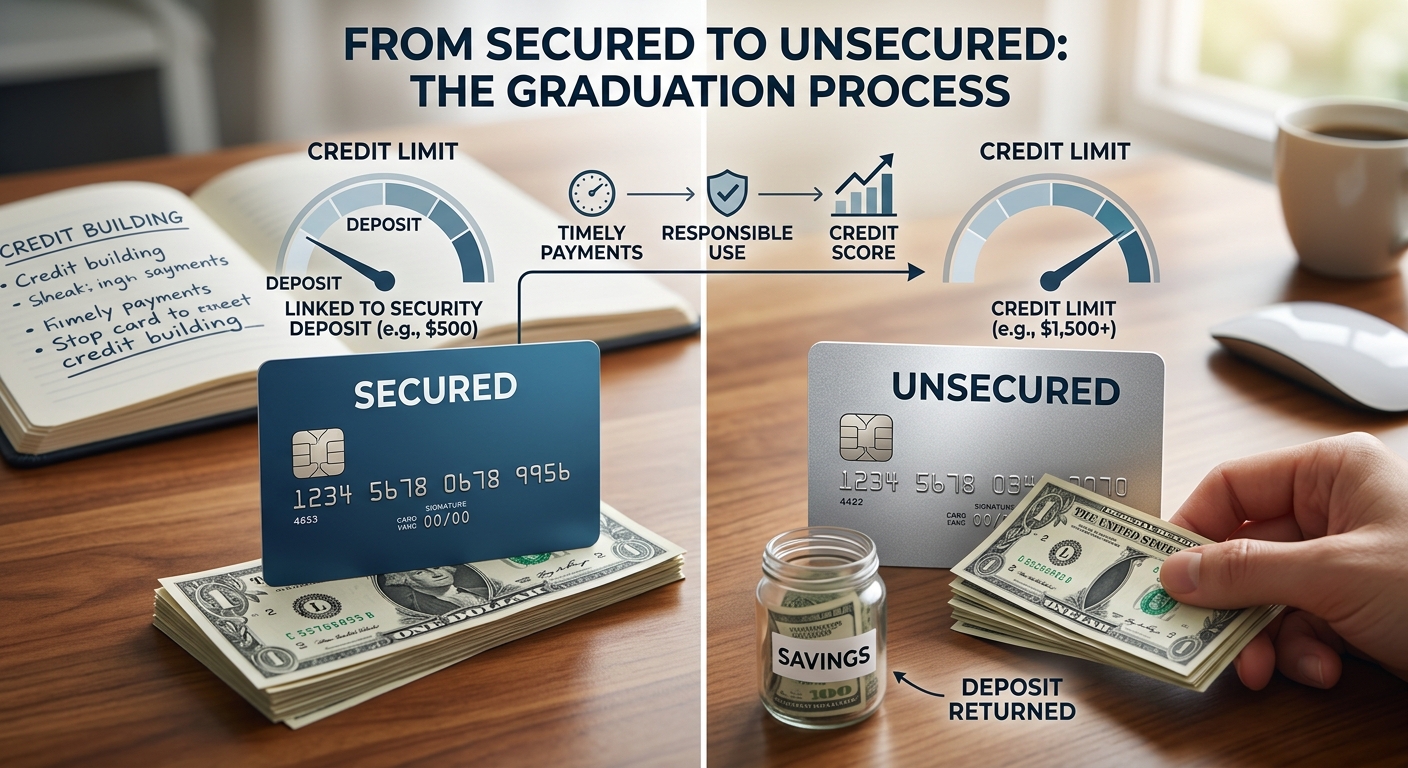
How to Graduate From a Secured Card to an Unsecured Card
«Graduating» is the term most issuers use for converting your secured card into an unsecured one — your deposit gets refunded, and going forward the card works like any other unsecured card, no collateral required. It’s a genuine milestone, but the process (and the timeline) varies more between issuers than most people expect.
The Two Paths to Graduation
Automatic review. Most issuers periodically review secured accounts in good standing to decide whether to offer an upgrade, without you having to request anything. Some publish an approximate timeline for this (historically around seven months for one well-known card, for example — see our Discover it Secured review for that specific case); others describe it as an ongoing, unscheduled process based on your account history (Capital One’s approach, covered in our Capital One Platinum Secured review).
Requesting it yourself. Some issuers will consider an upgrade request if you call and ask, even outside their standard review cycle — particularly if you’ve had the account open for a while with a clean payment history and can point to improved financial circumstances (higher income, an established credit history elsewhere). This doesn’t guarantee anything, but it costs nothing to ask, and it’s worth trying if it’s been a year or more with no automatic review.
What Issuers Typically Look For
While the exact criteria differ by issuer, a few factors show up consistently in graduation decisions:
- A consistent on-time payment history, ideally with no late payments at all since opening the account
- Low utilization over time, not just at the moment of review
- Updated income information, since issuers generally want to confirm your ability to responsibly manage a card without the deposit as a backstop
- Overall account standing, including whether you’ve had any returned payments or other account issues
There’s no universal formula, and issuers don’t typically publish exact thresholds — the guidance above reflects commonly reported patterns, not a guaranteed checklist.
Does Graduating Preserve Your Account’s Age?
This is the detail most beginners don’t think to ask about, and it matters more than it might seem. When an issuer upgrades your existing secured account to unsecured — rather than you closing that account and opening a brand-new unsecured card, even with the same bank — the account generally continues as the same tradeline, which in most cases means your original open date is preserved rather than reset. Since length of credit history is a real scoring factor that can’t be shortcut (see our complete credit-building timeline), this is a meaningful reason to prefer waiting for an in-place graduation over closing your secured card and applying for an unsecured one elsewhere, even if the unsecured option looks more attractive on paper.
That said, exact treatment can vary by issuer, so it’s worth confirming this specifically with your card issuer rather than assuming it’s guaranteed — but the general pattern is real enough to factor into your decision.
What Actually Happens, Step by Step
- You’re notified of the upgrade, either after an automatic review or after a request you initiated.
- Your deposit is refunded, typically via check, statement credit, or direct deposit, depending on the issuer’s process.
- Your account converts to unsecured, often keeping the same account number and, generally, the same original open date.
- You may receive a new physical card, even though the underlying account continues uninterrupted.
- Your credit limit may or may not change immediately. Some issuers keep your limit the same as your former deposit amount at first, with future increases considered separately; others reassess your limit as part of the upgrade itself.
If You’re Not Offered an Upgrade After a Long Time
There’s no fixed point at which an upgrade becomes guaranteed. If a meaningful amount of time has passed — commonly cited guidance suggests checking in after about a year if you haven’t heard anything — it’s reasonable to call your issuer directly and ask where you stand. If they’re not able to offer an upgrade, you still have options: keep the secured card open (preserving its age) while separately applying for an unsecured starter card elsewhere, rather than closing the secured account to make room for something new.
Should You Close Your Secured Card Once You’re Upgraded (or Get a New Card Elsewhere)?
Once you’re graduated, there’s nothing left to close — it’s simply your card now, unsecured. But if you instead choose to open a separate unsecured card elsewhere while keeping your original secured card open, resist the urge to close the older account just because it feels like the «starter» card you’ve outgrown. An older account, even one you rarely use, continues to help your average account age for as long as it stays open. We cover this decision in more depth in our guide to whether you should close your first credit card.
Frequently Asked Questions
How long does graduation usually take? It varies significantly by issuer — some review automatically around the six-to-twelve-month mark, others don’t commit to any specific timeline. Check your specific card’s stated process, or ask directly if nothing is published.
Do I need to request my deposit refund, or is it automatic? This depends on the issuer’s process — some refund automatically as part of the upgrade, others require you to confirm your current mailing address or banking details before releasing it. Watch for communication from your issuer around the time of an upgrade so you don’t miss a required step.
Will my credit limit increase when I graduate? Sometimes, but not always immediately — some issuers keep your limit consistent with your former deposit at first and consider increases separately over time, based on continued good standing.
If I’m not upgraded automatically, does that mean something is wrong with my account? Not necessarily. Some issuers simply don’t run automatic reviews at all and expect cardholders to request consideration directly — a lack of automatic upgrade isn’t inherently a sign of a problem with your account.
This article is for informational purposes only and is not financial advice. Graduation timelines, criteria, and account-continuity treatment are determined entirely by each card issuer and can vary — confirm your specific card’s process directly with the issuer.