
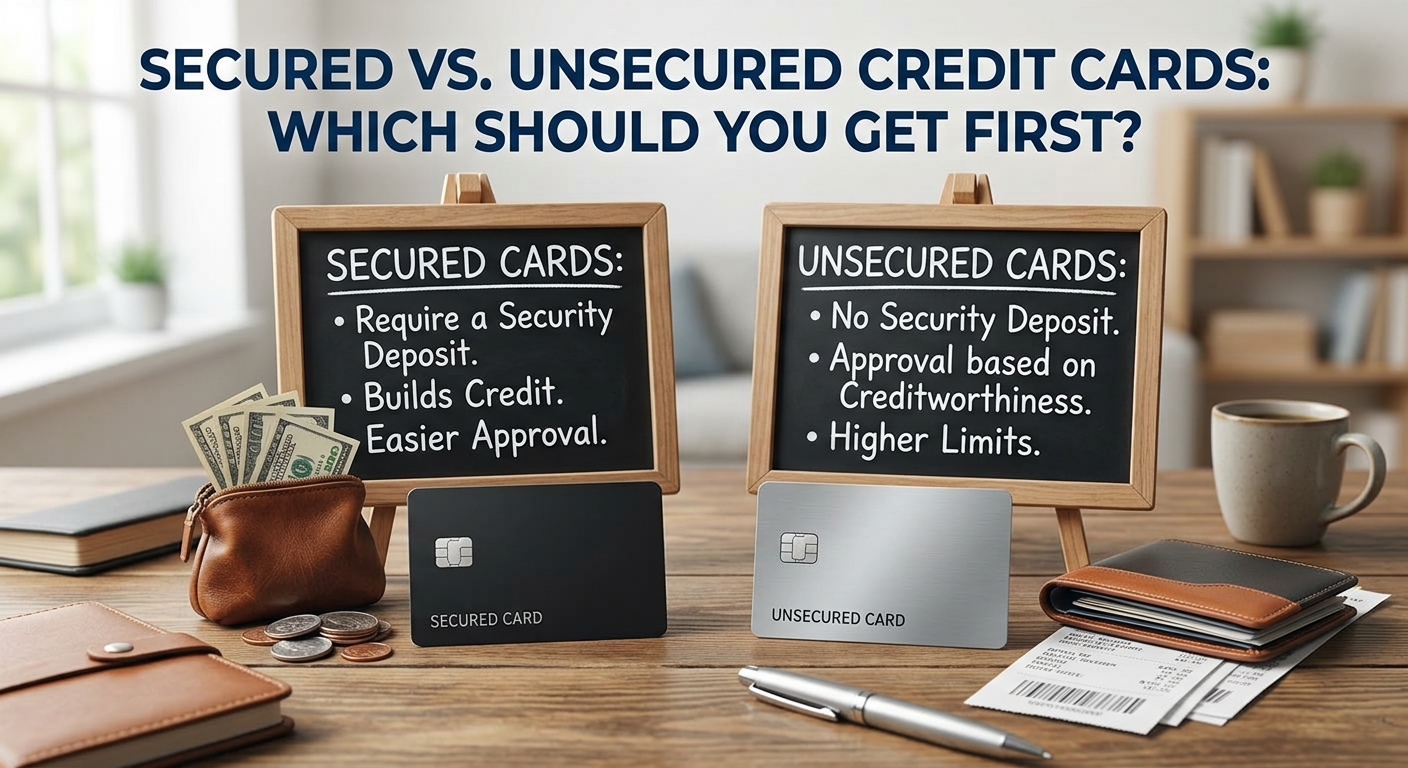
Secured vs. Unsecured Credit Cards: Which Should You Get First?
Secured cards get recommended to beginners so often that it’s easy to assume they’re the only realistic starting point. They’re not — for some people, an unsecured starter card is a perfectly viable first move, and for others, a secured card genuinely is the better call. Here’s how to actually tell which applies to you.
The Real Difference (It’s Narrower Than You Might Think)
The core mechanical difference is simple: a secured card requires a refundable cash deposit that typically becomes your credit limit. An unsecured card requires no deposit — your credit limit is based on the issuer’s assessment of your creditworthiness instead.
What doesn’t automatically differ, contrary to a common assumption, is how the card builds your credit. Both report to the credit bureaus the same way, using the same account information — your payment history, your balance, your limit. A well-managed secured card builds credit exactly as effectively as a well-managed unsecured one. The deposit affects your risk to the issuer, not how the bureaus or scoring models treat the account.
It’s also worth debunking a related myth directly: secured cards are not automatically cheaper to carry. APR is generally tied to the issuer’s overall risk assessment of the specific card product, not to whether it’s secured — it’s common to see secured card APRs in the high-20s%, similar to or even higher than many mainstream unsecured cards.
When a Secured Card Is the Better First Move
- You have no credit history at all, and haven’t been added as an authorized user on anyone else’s account. Most unsecured cards, even «starter» ones, still run some form of credit assessment that a completely empty file can struggle to pass.
- You’ve already been denied for an unsecured card. A secured card’s approval odds are generally higher precisely because the deposit reduces the issuer’s risk, regardless of your credit file’s thinness.
- You want the most predictable approval odds available, especially with cards that involve minimal or no credit check (see our best secured cards guide for specific options).
- You’re rebuilding after a period of no active accounts, even if you technically have some history, and want the highest-confidence approval path.
When You Might Be Able to Skip Straight to Unsecured
- You’re already an authorized user on a well-managed account. If that account’s history is showing up on your report, you may already have enough of a file to qualify for a genuine starter unsecured card — it’s worth checking your score before assuming you need to start from a deposit.
- You qualify for a student credit card. A number of issuers offer unsecured cards specifically for college students with little to no credit history, often with more forgiving approval criteria than their general-market unsecured cards.
- You have a steady income and an existing banking relationship. Some banks will extend a small unsecured starter card to an existing customer with a solid deposit and income history, even without a long credit file, based on that banking relationship rather than credit history alone.
- A retail or store card is available to you. Store-branded cards often have more lenient approval criteria than general-purpose unsecured cards, though usually with a lower limit and narrower usefulness (see our guide on best secured cards for college students for how this compares for that specific group).
Side-by-Side Comparison
| Secured Card | Unsecured Card | |
|---|---|---|
| Upfront cost | Refundable deposit (ties up cash temporarily) | None |
| Approval odds for thin/no file | Generally higher | Generally lower, unless a starter-specific product |
| Credit limit | Usually equals your deposit | Based on issuer’s risk assessment |
| APR | Comparable to or sometimes higher than unsecured cards | Varies widely by product |
| How it builds credit | Identical mechanism — reports the same way | Identical mechanism |
| Path forward | Often upgrades to unsecured after a review period | Already unsecured |
The «cost» of a secured card isn’t really a cost in the traditional sense — it’s an opportunity cost. Your deposit isn’t spent, it’s just temporarily unavailable for other use, and it comes back to you (assuming the account stays in good standing) either when you close it or when the issuer upgrades you automatically.
A Simple Way to Decide
Ask yourself these three questions in order:
- Do I have any credit history at all right now? If genuinely none, and no one can add you as an authorized user, a secured card is very likely your most reliable first step.
- Have I already tried and been denied for an unsecured starter or student card? If yes, a secured card sidesteps that denial risk almost entirely.
- Can I comfortably set aside $100–$300 for a few months to a year without it creating financial strain? If the deposit would be a genuine hardship, it’s worth specifically looking for the lowest-deposit secured options, or seriously exploring the unsecured and authorized-user paths described above before committing to tying up cash you need elsewhere.
If you answered «no credit history,» «yes, already denied,» or «the deposit is comfortable» — a secured card is a reasonable, low-risk starting point. If none of those apply and you have some kind of existing financial relationship or thin file to work with, it’s worth at least checking whether an unsecured starter option is realistically available before defaulting to a secured card.
Frequently Asked Questions
Does having a secured card look worse to future lenders than an unsecured one? No. Once an account is reporting to the bureaus, lenders reviewing your file generally see the account type (credit card), your limit, your balance, and your payment history — not a flag indicating whether the card started out secured.
Can I just apply for both and see what happens? You can, but each application typically creates a hard inquiry, so applying broadly «to see what sticks» isn’t a great strategy for someone with a thin file — it adds inquiries without necessarily improving your odds, and can slightly lower your average account age once you do open something.
Is it ever worth getting a secured card even if I could qualify for unsecured? Occasionally — if the secured card has meaningfully better terms (lower APR, cash back, no annual fee) than the unsecured options realistically available to you, the deposit tradeoff can be worth it purely on the product’s own merits, independent of the «beginner» use case.
How do I know when I’m ready to move from secured to unsecured? Many secured cards include an automatic review after a set period (often around 6–12 months) of on-time payments, after which the issuer may upgrade you and refund your deposit. Check your specific card’s terms, since this process varies by issuer.
This article is for informational purposes only and is not financial advice. Approval criteria and card availability vary by issuer and by individual financial circumstances.