
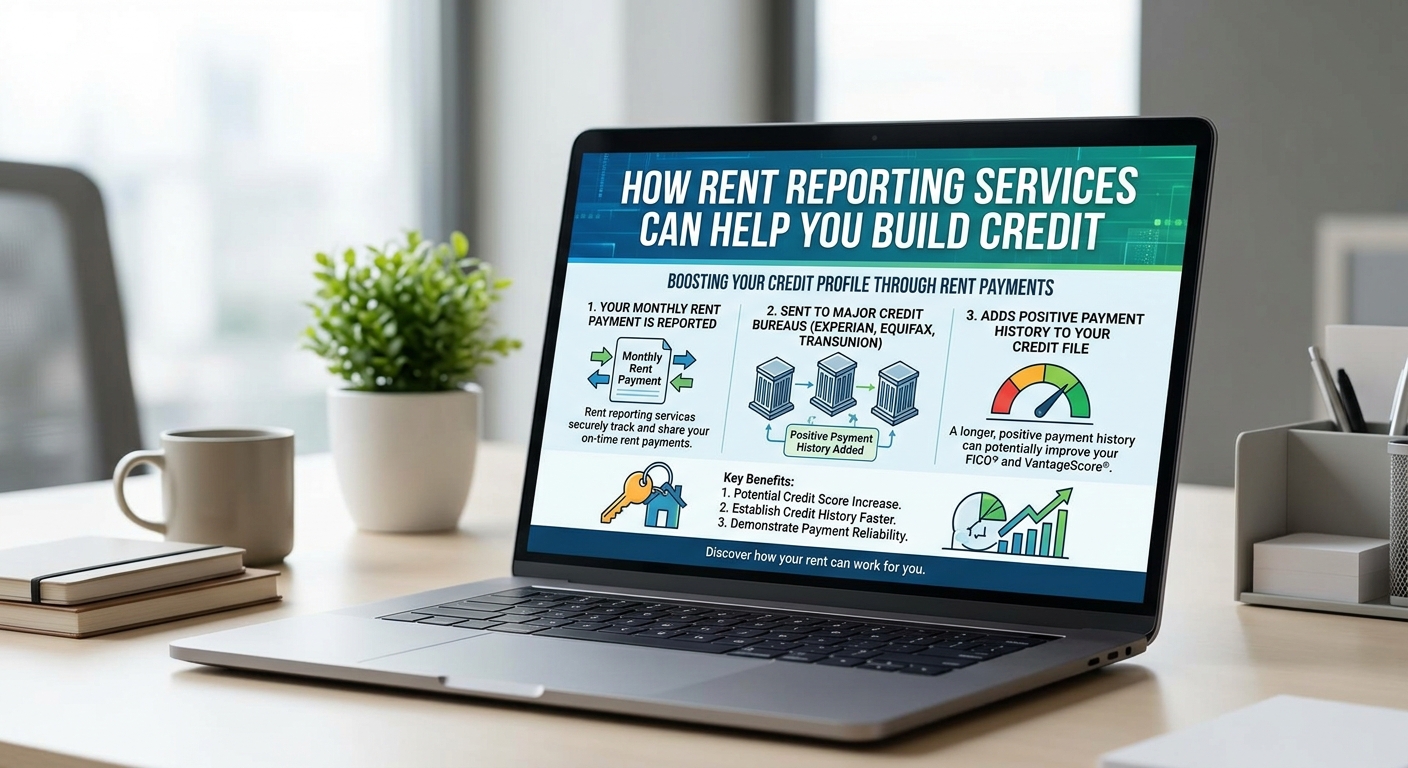
How Rent Reporting Services Can Help You Build Credit
For most renters, rent is the single largest recurring payment they make. Yet for decades, none of it showed up on a credit report at all, no matter how reliably it was paid. Rent reporting services close that gap by adding your rent payment history to your credit file. Maybe you’ve already looked into Experian Boost’s free rent reporting, covered in our dedicated review, and it didn’t fit your situation. For example, you might pay by check or a peer-to-peer app rather than a qualifying platform. If so, this is the broader landscape of dedicated services built specifically around rent. Most of these report more broadly, and can look further back, than Boost does.
How Rent Reporting Services Actually Work
Regardless of which service you use, the basic mechanism is similar. Your rent payments get verified through one of a few methods. That could be a linked bank account, an uploaded receipt, or direct confirmation from your landlord or property manager. That payment history then gets reported to one or more credit bureaus, as a trade line on your credit file. Because rent is typically a larger, more consistent monthly payment than most other bills, it can meaningfully contribute to your payment history. That’s true once it’s actually being reported — which is the piece these services add that wasn’t there before.
The First Filter: Does Your Service Require Landlord Participation?
This matters more than any feature comparison, because it determines which services you can even use. Several rent-reporting services require your landlord or property manager to actively participate, verifying your lease and payment records directly. Others let you enroll independently and verify your own payments.
Tenant-enrollable, no landlord required: Piñata and Boom both let you sign up and verify payments yourself, typically via bank-account linking or receipt upload. Cash or check payers may still need landlord confirmation, specifically for those payment methods.
Landlord participation required: Rental Kharma, RentReporters, Rock the Score, Credit Rent Boost, and RentTrack all require landlord or property-manager involvement. That’s needed at least for verifying your payment history. If your landlord is a large corporate property manager, it’s worth checking whether they already use one of these services or a similar reporting feature. That way, you’re not assuming you need to sign up for anything separately.
Effectively landlord/property-manager-paid: Esusu Rent is structured primarily as a service landlords or property managers adopt. Sometimes they pass a portion of the cost to tenants, rather than something an individual renter typically signs up for directly. If you’re interested in Esusu specifically, the more realistic path is asking your property manager whether they already offer it. That’s a better approach than trying to enroll independently.
If your landlord won’t participate, and isn’t likely to, that alone rules out several of the options above. Piñata and Boom are the more realistic starting points for self-service enrollment, without needing anyone else’s cooperation.
Comparison Table
| Service | Bureaus Reported | Cost (Ongoing) | Retroactive Reporting | Landlord Required |
|---|---|---|---|---|
| Piñata | All 3 | Free tier available; $5/month paid | Yes, up to 24 months (fee) | No (except cash/check payers) |
| Boom | All 3 | ~$5/month or $60/year | Yes, up to 24 months ($25 one-time) | No |
| Self (rent feature) | All 3 | Confirm current pricing directly (sources vary — see note) | Yes, up to 24 months ($49.95 one-time) | No |
| Rental Kharma | TransUnion, Equifax only | $8.95/month ($75 setup) | Yes | Yes |
| RentReporters | All 3 | $10.95/month, or $8.95/month billed annually ($94.95 setup) | Yes, up to 24 months | Yes, for historical reporting |
| Rock the Score | Equifax, TransUnion only | $6.95/month ($48 setup) | Yes, up to 24 months ($65 one-time) | Yes |
| Credit Rent Boost | All 3 | $6.95–$12.95/month, or $49–$117/year | Yes, up to 24 months (fee) | Yes |
| RentTrack | All 3 | Monthly subscription + $6.95/person | Yes ($50 one-time) | Yes |
| Esusu Rent | All 3 | Primarily landlord-paid | Yes, up to 24 months | Yes (property-level adoption) |
(Pricing and terms change and vary somewhat between sources — confirm current details directly with any service before enrolling.)
Retroactive Reporting: The Feature Experian Boost Doesn’t Really Offer
This is one of the clearest reasons to look beyond the free option. Most dedicated rent-reporting services can report up to 24 months of past rent payments, not just payments going forward. Say you’ve been paying rent reliably for a year or two already. That history can be added to your credit file essentially all at once, usually for a one-time fee separate from the ongoing subscription cost. That’s different from needing to wait for new months to accumulate. It’s also meaningfully different from how Boost works. Boost’s rent category depends on transaction history it can already see through your linked bank account and specific qualifying platforms. That’s different from a dedicated retroactive-reporting product built around rent specifically.
How Much Does This Actually Help?
One frequently cited figure, from Piñata, suggests an average score increase of around 60 points within the first year of consistent reporting. That’s a company-reported statistic, though, not an independent study. It’s worth treating the same way we’ve flagged similar company-reported figures elsewhere, like Self’s 32 points or Kikoff’s 58 points. In short, it’s a real directional signal, not a guaranteed or independently verified outcome for every individual file.
What’s mechanically reliable, regardless of the exact figure, is simple. A large, consistently on-time payment added to your credit history contributes to payment history — the single heaviest scoring factor. If it’s your only reported account, or one of just a few, it can also help account age and overall file thickness. It’s a genuinely different kind of account than a secured card or credit builder loan. Also, it doesn’t require opening any new credit account or committing to a deposit.
Is It Worth Paying For?
This depends heavily on your situation:
- Check whether Experian Boost already covers you. That requires your rent to be paid through a qualifying platform. It also requires that Experian-only, FICO 8-only reporting is good enough for your goals. If both are true, the free option may be all you need. See our full Experian Boost review before paying for anything else.
- If you pay by cash, check, or a peer-to-peer app, or want broader bureau coverage than Experian alone, a paid dedicated service becomes worth considering. Weigh the setup and ongoing fees against how much rent history you’d be adding, and how long you plan to keep paying for the subscription.
- If your landlord already reports rent through their own property management software, check before paying for anything. It’s worth a direct question to your property manager, since it could make an entirely separate paid service redundant.
A Few Things Worth Checking Before You Enroll
- Confirm exactly which bureaus a service reports to before assuming «all three» — Rental Kharma and Rock the Score, for example, notably don’t include Experian.
- Ask directly whether a lender you’re planning to apply with actually uses scores that reflect rent trade lines. Similar to Experian Boost’s model-specific limitation, not every lender’s scoring model weighs a rent account the same way.
- Understand the retroactive reporting fee structure separately from the ongoing subscription. These are usually billed as two different charges. So it’s easy to underestimate your total first-year cost, if you only look at the monthly price.
Frequently Asked Questions
Can I use a rent reporting service and Experian Boost at the same time? Generally, yes — though check for overlap first. If a dedicated service is already reporting your rent to all three bureaus, Boost’s Experian-specific rent category may become redundant for that specific payment. However, Boost’s other qualifying bill categories, like phone, utilities, and streaming, would still be worth using independently.
Will rent reporting hurt my credit if I pay late? Potentially, yes. Depending on the specific service, a late or missed rent payment could be reported just as a late credit card or loan payment would be. So enrolling in rent reporting is a commitment to consistency, not a risk-free addition.
Does rent reporting affect my credit utilization? No. Rent reporting generally doesn’t function as a revolving account, the way a credit card does. So it doesn’t interact with utilization. Its main contribution is to payment history and account age or file thickness.
If my landlord won’t participate, am I out of options? No. Piñata and Boom specifically don’t require landlord participation for most payment verification methods. That makes them the more realistic starting point if landlord cooperation isn’t available to you.
This article is for informational purposes only and is not financial advice. Rent reporting service costs, bureau coverage, and terms change over time and vary by source — confirm current pricing and reporting details directly with any service before enrolling.