
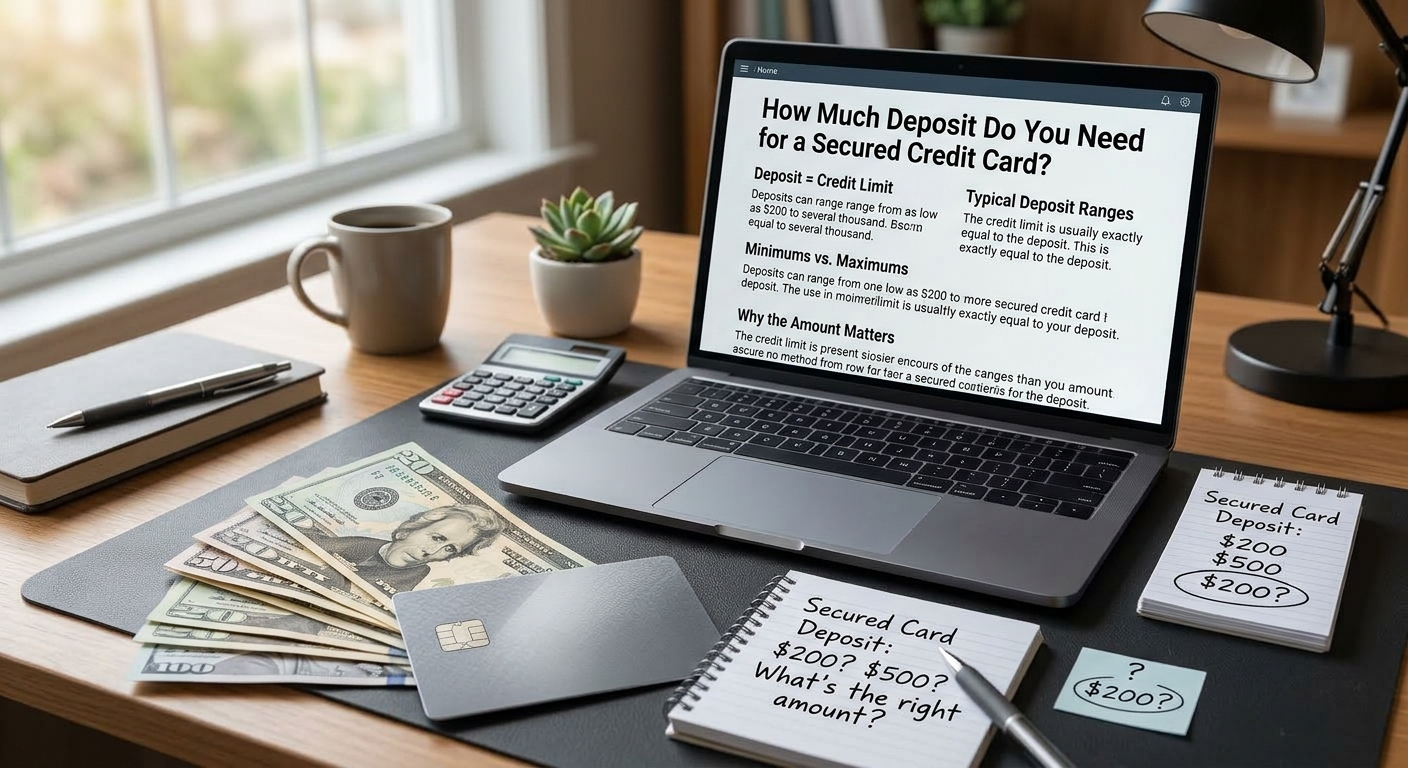
How Much Deposit Do You Need for a Secured Credit Card?
The honest answer is: it depends entirely on which card you’re looking at. The range is wider than most people expect too — anywhere from under $50 to several thousand dollars. So here’s what actually determines that number, and a framework for deciding how much makes sense for you specifically.
The Range, in Real Terms
Minimum deposits across secured cards currently on the market span a wide range. Some issuers offer tiered minimums as low as $49–$99, for applicants who qualify. Others set a flat $150–$300 minimum, regardless of your situation. And a few allow deposits up into the thousands, if you want a higher starting limit. (For a full breakdown of specific cards and their exact minimums, see our best secured credit cards comparison and our no-annual-fee roundup.) However, the point here isn’t which card has which number. It’s understanding why the number varies so much in the first place.
What Actually Determines the Minimum
Issuers set deposit minimums based on their own risk models, not a shared industry standard. A few patterns show up repeatedly:
- Flat minimums are the most common approach — a fixed dollar amount every approved applicant must meet, regardless of their specific financial picture.
- Tiered minimums work differently. Your income and existing debt, evaluated even without a credit score, determine which tier you’re offered. That can result in a lower minimum for some applicants than others, on the exact same card.
- A maximum deposit ceiling is common too. It caps how much you can put down, even if you wanted a higher limit. This varies from card to card, and a few effectively cap you in the low thousands.
None of this is negotiable from your side. You can’t request a specific deposit amount outside what a given card’s structure allows. However, you often can choose to deposit more than the required minimum, up to that card’s cap.
Deposit and Credit Limit Are Usually the Same Number
For most secured cards, your credit limit equals your deposit, dollar for dollar. Put down $200, get a $200 limit. This is the single most important thing to understand before choosing an amount. Because of it, your deposit decision isn’t just about how much cash you’re comfortable setting aside. It also directly determines how much room you’ll have to keep your utilization low. (See our guide on credit utilization for why that matters so much to your score.)
A smaller deposit means a smaller limit, which means even modest spending can represent a large percentage of your available credit. A $50 balance is 25% utilization on a $200 limit, but only 5% on a $1,000 limit.
Should You Deposit More Than the Minimum?
Say a card allows it, and you can comfortably afford it. Depositing more than the required minimum has one clear benefit: more available credit gives your utilization more room to stay low, without you having to obsessively track every purchase. But the tradeoff is straightforward too. That extra money is tied up and inaccessible to you, until the account closes or you’re upgraded to unsecured.
Here’s a reasonable way to think about it. If you can deposit enough that your typical monthly spending stays comfortably under 10% of your limit, without any special effort, that’s a solid target. On the other hand, if putting down that much would create real financial strain, the minimum is a perfectly reasonable starting point. You can always manage a smaller limit carefully, by keeping balances especially low relative to it.
Is Your Deposit Actually Safe?
This is a fair question, especially the first time you’re asked to hand over cash to open a credit account. In legitimate secured card programs, your deposit is held by the issuing bank, typically in an FDIC-insured account, separate from your line of credit. It’s not «spent» or put at risk. Instead, it’s specifically designated as collateral against your card balance. It’s refundable when the account closes in good standing, or when you’re upgraded to unsecured. However, watch for a card that asks for a deposit through an unusual payment method — a personal wire transfer, gift cards, or cryptocurrency. That’s a serious red flag. The same goes for a card that won’t clearly explain how the deposit is held. Legitimate issuers are transparent about this, and none of the reputable cards covered on this site work that way.
Getting Your Deposit Back
You generally get your deposit back in one of two situations. First, you close the account, after paying off any remaining balance. Second, the issuer reviews your account and upgrades you to an unsecured card. At that point, the deposit that was securing your limit gets refunded, since it’s no longer needed as collateral. Timelines and processes for this vary significantly by issuer. Some review automatically on a set schedule; others don’t commit to a specific timeline at all. We cover the graduation process in detail separately.
What to Do If You Can’t Afford Even the Minimum Deposit
If even a $100–$200 deposit would be a genuine stretch right now, a secured card isn’t your only path. A credit builder loan doesn’t require a lump-sum deposit upfront. Instead, you make smaller monthly payments toward a loan amount (see our credit builder loans guide). Some providers, like Self, also offer a savings-based path that lets you build toward a card deposit gradually rather than all at once. There’s no urgency to force a deposit you can’t comfortably afford. Starting a few months later, with a stable financial footing, beats opening an account that creates strain from day one.
Frequently Asked Questions
Can I get my deposit back if I change my mind right after opening the account? Generally, yes — though the process, and any conditions, varies by issuer. Check the specific cancellation terms for your card, since some may require the account to be paid in full first.
Does a bigger deposit mean I’ll build credit faster? Not directly — payment history and consistent low utilization matter more than the raw size of your limit. A bigger deposit mainly makes it easier to maintain low utilization without close tracking, not faster in itself.
Do I earn interest on my deposit while it’s held? Typically no. Most secured card deposits don’t earn interest, since they function as collateral rather than a savings product. So confirm this specifically with your card, as it can vary.
What happens to my deposit if I miss payments? If your account goes seriously delinquent, the issuer can apply your deposit toward the amount you owe, rather than refunding it. That’s another reason consistent on-time payment matters, beyond just your score.
This article is for informational purposes only and is not financial advice. Deposit amounts, limits, and refund processes are determined entirely by each card issuer and can change — confirm current terms directly on the issuer’s official site before applying.