
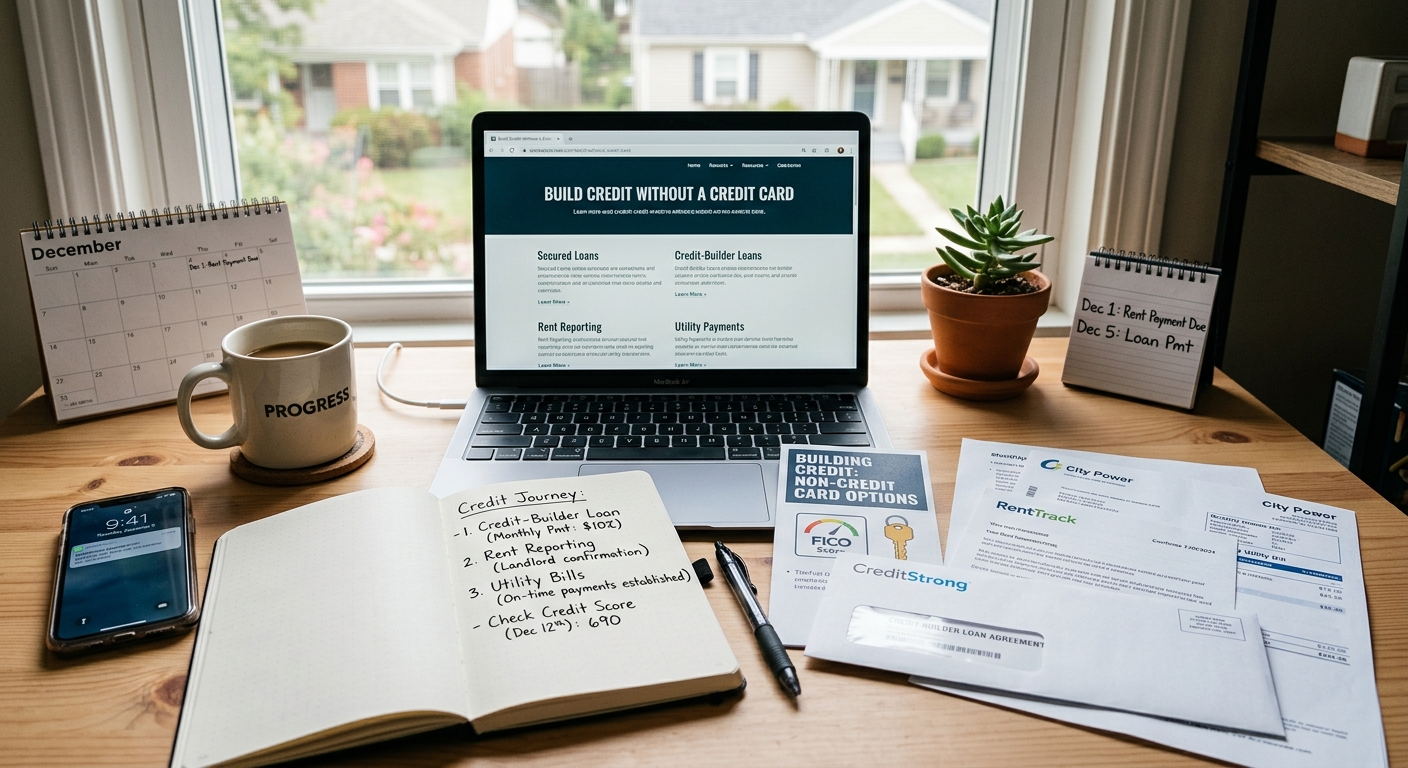
Can You Build Credit Without a Credit Card at All?
Yes. You can build a real, usable credit file without ever applying for a credit card, secured or unsecured. Several tools on this site already do exactly that. But there’s one honest tradeoff worth knowing before you commit to a fully card-free path — we’ll get to that after the options.
The Full Menu of Card-Free Paths
Credit builder loans
These report as installment accounts and never involve a card at all. You make fixed payments, and the funds are released back to you at the end of the term. See our full comparison of providers and our dedicated Self review for how this works in practice.
Kikoff
Kikoff issues no card you carry or swipe. Its “credit line” only ever pays its own monthly subscription fee — you can’t spend it anywhere else. It still reports as a revolving tradeline, which makes it a genuine exception to the installment-only pattern below. See our full Kikoff review for the mechanics.
Rent reporting
Rent is often your largest recurring payment, and several services add it to your credit file without requiring any new account at all. See our rent reporting comparison for current options, including ones that don’t need landlord cooperation.
Utility and phone bill reporting
Similar idea, smaller payments. Experian Boost does this for free, though only for your Experian file. See our full Experian Boost review and our dedicated utility-bill explainer for the details, including a specialty reporting agency most people don’t know exists.
Becoming an authorized user
This requires no application of your own. A family member or trusted friend adds you to their existing card, and their account history can begin appearing on your report. You never need to qualify independently, since you’re not the primary applicant.
Other installment loans
A student loan, an auto loan, or a personal loan all report the same way a credit builder loan does. If you already have one of these for an unrelated reason, it’s already contributing to your credit file, whether or not you think of it as a “credit-building” tool.
What’s Explicitly NOT on This List
Chime’s Credit Builder card is a real Visa card, even though it lives in this site’s Credit Builder Tools category alongside these other options. If avoiding a card specifically is your goal, Chime doesn’t fit that goal — see our full chime review if you’re open to reconsidering that constraint.
The Tradeoff Nobody Mentions
Here’s the honest part. Nearly every option above builds installment or reporting-based history. None of them — except Kikoff, and a card itself — touch your credit utilization, which is roughly 30% of your score and one of the two heaviest-weighted factors overall.
That doesn’t mean a card-free approach is weak. It means your credit file will likely be thinner on one specific dimension than someone who also holds a well-managed revolving account. If you eventually want a fuller credit mix, adding one revolving account later — Kikoff, or a secured card once you’re ready — rounds that out. You don’t have to do it now, and you don’t have to do it at all. But it’s worth understanding the shape of the file you’re building, not just that you’re building one.
A Reasonable Card-Free Combination
If avoiding a card is a firm preference, not just a starting point, a strong combination looks like this: a credit builder loan for installment history, rent or utility reporting for payment history breadth, and Kikoff if you want some revolving-utilization benefit without ever holding a spendable card. Together, these cover more of the scoring picture than any single tool alone.
Frequently Asked Questions
Will lenders think less of me for not having a credit card?
No. Lenders evaluate your file as a whole — payment history, account age, utilization where applicable, and mix. A thinner file on one factor isn’t a red flag by itself; it’s simply one input among several.
Can I add a credit card later without losing progress from these card-free tools?
Yes. Adding a card later doesn’t erase or reset anything you’ve already built. It simply adds a new account and, if managed well, starts contributing its own utilization data going forward.
Is Kikoff really a card-free option if it’s technically a credit line?
In the practical sense this article uses, yes — you never receive a physical or virtual card, and you can’t spend the line on anything but its own subscription fee. It’s the one option here that still reports as revolving, which is exactly why it’s included despite that technical nuance.
Do these tools work as well as a secured card for someone with zero history?
They work through different mechanics, not lesser ones. A secured card’s advantage is direct utilization impact; these tools build the rest of your file just as legitimately, just through different scoring factors.
This article is for informational purposes only and is not financial advice. Product availability, terms, and reporting behavior vary by provider and can change — confirm current details directly before enrolling in any tool mentioned here.